·
6 minutes
Midnight Grid ES, NQ and YM Case Study: March 3, 2026

Algorithmic
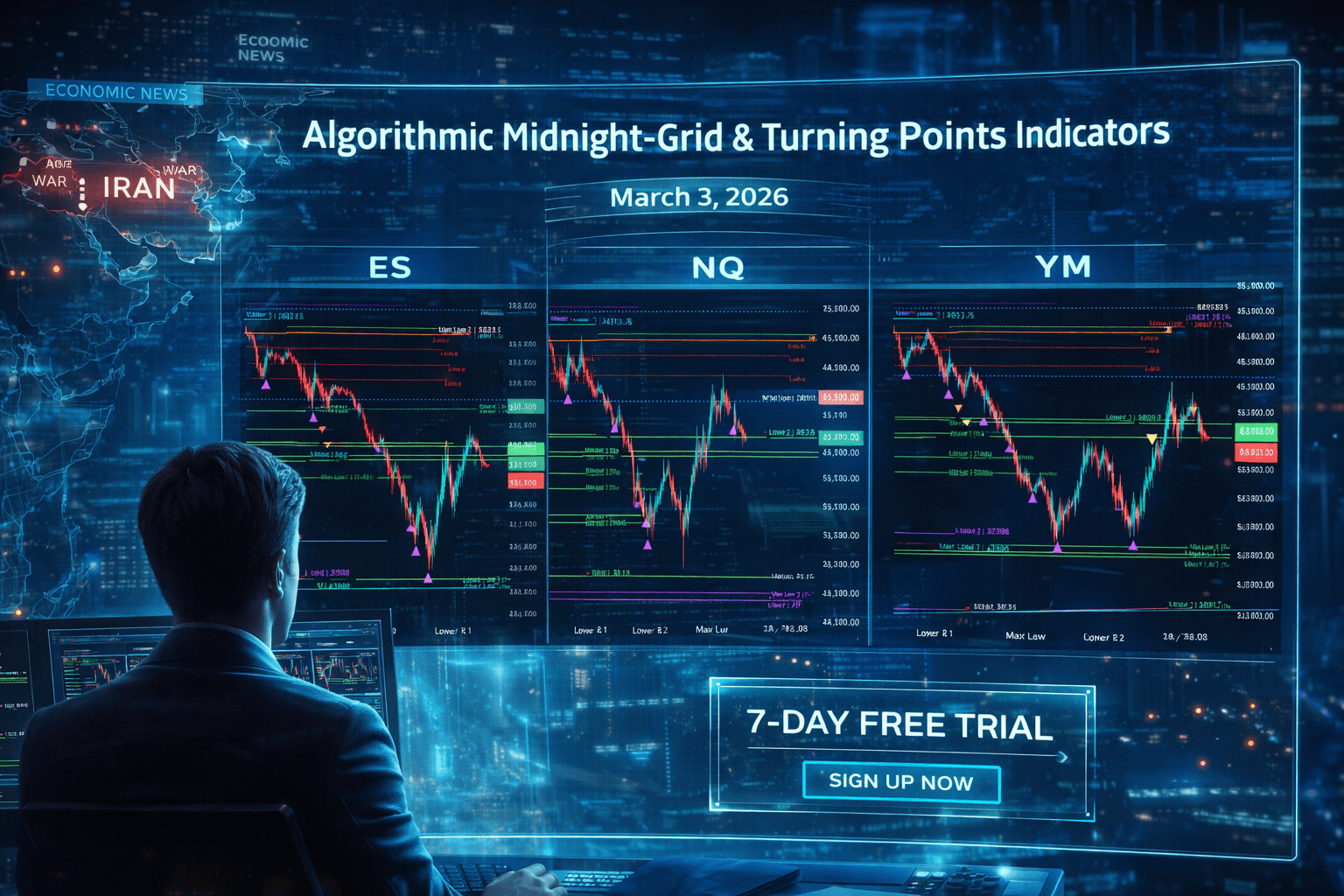
On March 3, 2026, I reviewed ES, NQ, and YM with Midnight Grid levels already plotted on my TradingView charts. This is a single-session case study of how I used the framework for preparation and review. It is not proof of predictive accuracy, a mechanical entry-and-exit strategy, or a promise of similar results.
What was fixed before the session
Midnight Grid published the session map at Midnight ET. The reference levels stayed unchanged as the session developed. That matters because a level that remains fixed can be reviewed honestly after the fact; it cannot be moved to make the chart look better.
The charts also displayed Turning Points. These markings appear only after a bar meets the indicator's criteria and closes. They add context to the review, but they are not automatic buy or sell instructions.
How to read this case study
The purpose is to show a workflow:
Prepare with the same map you will review later.
Observe how price behaves around predefined areas.
Compare ES, NQ, and YM for agreement and divergence.
Record what happened without redrawing the chart.
A trader still needs independent rules for entries, exits, position size, and risk. Midnight Grid organizes the session; it does not make those decisions.
The multi-index view
ES, NQ, and YM often share broad index-futures flows, but they do not move in lockstep. Comparing them can help distinguish broad participation from a move isolated to one contract. It can also expose disagreement that argues for patience.
On this date, the review focused on how the three contracts behaved near their pre-session lower and upper reference regions. The useful information was not a claim that confluence guarantees a trade. It was the ability to compare three charts against levels that had been established before the main session unfolded.
ES session review
ES moved through several areas on the pre-session map. The review asked three simple questions: Did price pause, reject, or move through a level? Did that behavior persist after the next bar? Did the other indexes support or contradict the observation?
That approach avoids turning every touch into a signal. A level can provide context even when no trade is justified. The chart remained useful because the reference points did not change after the move.
YM session review
YM offered a second view of the same session. Its interaction with the lower and upper regions could be compared with ES and NQ without inventing new lines intraday.
Turning Points marked qualifying bars after they closed. In review, those markings helped identify where short-term behavior changed. They did not establish, by themselves, where risk should be placed or whether an entry was appropriate.
What this session can—and cannot—show
This case study can show that the software produced a stable session map and preserved the information visible during the day. It can show how I used that map to organize a multi-index review.
It cannot establish a win rate, expected return, or predictive edge. One session is not a backtest, and a clean historical chart is not evidence that every future session will behave the same way. Any performance claim requires a defined strategy, complete entry and exit rules, realistic costs, and testing across many independent observations.
A practical review workflow
Before the session, note the nearest Midnight Grid areas for ES, NQ, and YM.
During the session, observe rather than redraw. Record any decision you make and the rule behind it.
After the session, return to the unchanged map. Compare what you expected with what actually happened, including the times when price ignored a level or no valid setup appeared.
Over repeated sessions, that journal becomes more useful than a single dramatic screenshot. It shows whether the framework helps you prepare consistently and whether your own rules remain coherent around it.
Try the framework on your own charts
You can review Midnight Grid at https://www.algorithmic.io/software/midnight-grid and test the full Algorithmic Suite through the seven-day trial at https://www.algorithmic.io/pricing.
Use the trial to evaluate the software inside your own TradingView workflow. Do not treat this case study, or any indicator, as a substitute for risk management or an independently tested trading plan.