·
15 minutes
How to Pass a Futures Prop Firm Evaluation

Algorithmic
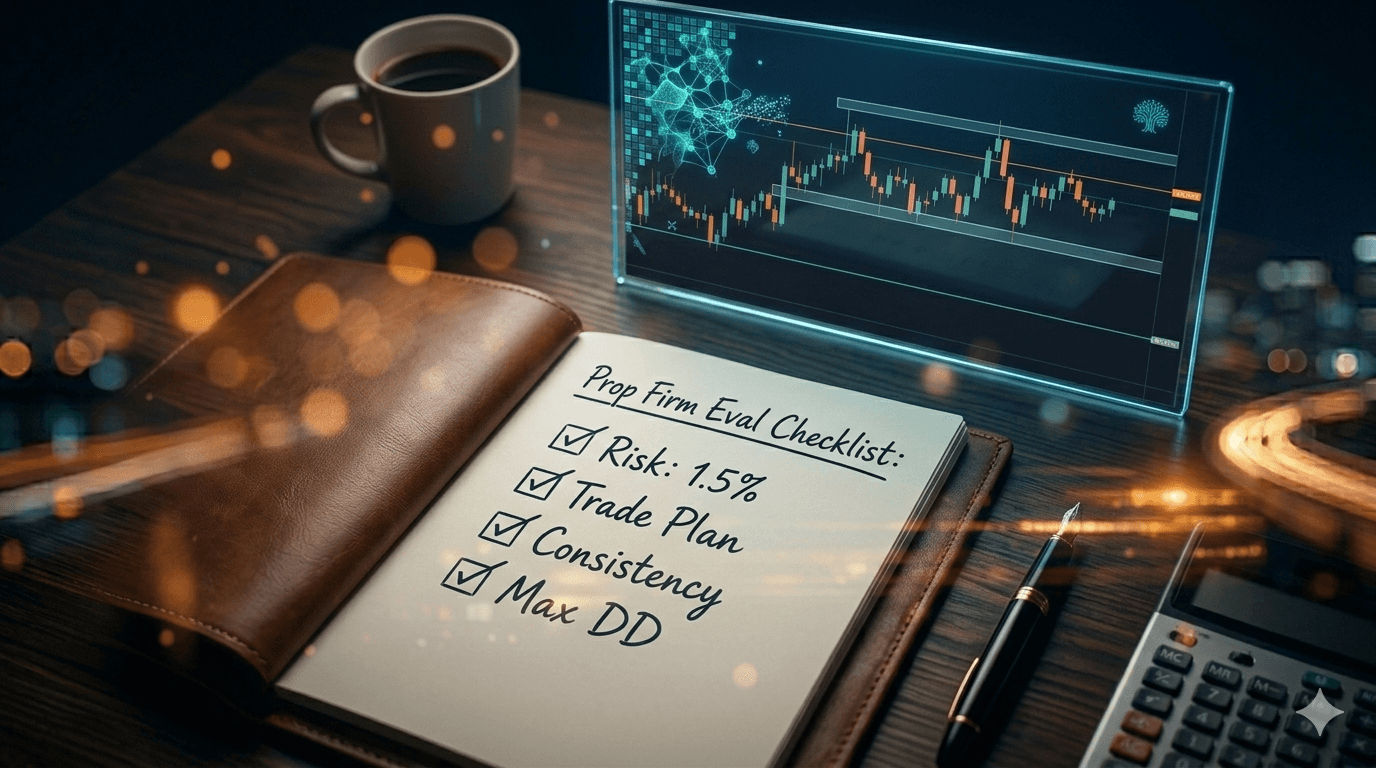
How to Pass a Futures Prop Firm Evaluation — A Data-Backed Strategy Guide
Search for how to pass a futures prop firm evaluation and every result on the first page has something in common.
They are all written by prop firms.
Topstep publishes guides about passing Topstep evaluations. Apex publishes guides about passing Apex evaluations. Every funded trader program has a blog section full of tips about how to succeed at the thing they sell.
There is nothing wrong with that. They understand their own rules better than anyone. But there is an obvious conflict of interest that nobody seems to mention. Prop firms make money when traders buy evaluations. They also make money when traders fail and buy another one. A guide that helped every reader pass on the first attempt would be a terrible business decision.
I am not selling evaluations. I build research-backed tools for index futures trading. My interest is in helping traders who use those tools perform well — including in prop firm evaluations. That means I can say things the prop firms themselves would rather not.
Like this: most prop firm evaluations are designed with pass rates that make the business model work. Not pass rates that reflect reasonable trading expectations. And most traders who fail do so not because they lack skill, but because they lack structure.
This guide is built from structure. Eighteen years of ES futures data. 89,774 qualifying signals across 4,721 trading sessions. Real transaction costs. Real maximum adverse excursion measurements. Not opinions from someone who passed an evaluation once and now sells a course about it.
The real pass rate and why most traders fail
The numbers that prop firms publish about their pass rates are not encouraging. Industry-wide, the data suggests that the vast majority of traders who purchase evaluations do not pass on their first attempt. Many do not pass at all.
This is not because futures trading is impossible. It is because most traders approach evaluations with no structured strategy, no defined risk budget, and no plan for what to do when a trade goes against them.
They trade the evaluation the same way they trade their personal account — which, for most retail futures traders, means discretionary entries based on gut feeling, inconsistent position sizing, and no systematic approach to session selection or trade management.
The evaluation is not the problem. The lack of preparation is the problem.
I built a framework backed by quantitative research that was originally designed for a different purpose — to identify and validate structural levels in index futures across nearly two decades of data. But the characteristics that make it robust for long-term analysis are exactly the characteristics that matter for passing an evaluation: consistency, defined risk parameters, and performance that holds up across different market regimes.
This guide takes what I know from that research and applies it to the specific problem of surviving an evaluation.
Step 1 — Understand the rules before trading a single contract
The first thing most traders do wrong is treat the evaluation like a regular trading account. It is not. It is a test with specific rules, and those rules dictate the strategy you should use.
Every prop firm has different rules. If you do not read them carefully — and do the math on what they actually mean — you are trading blind.
Topstep rules (as of early 2026)
Topstep offers $50K, $100K, and $150K evaluation accounts. The trailing drawdown thresholds are approximately $2,000, $3,000, and $4,500 respectively. This is an end-of-day trailing drawdown, meaning it only updates at the close of each trading session based on your highest end-of-day balance.
There are consistency requirements. You cannot pass by hitting one massive winner. The profit needs to be distributed across multiple trading days.
Apex rules (as of early 2026)
Apex uses a Safety Net model. Their end-of-day trailing drawdown and daily loss limits vary by account size. For a 100K EOD account, the daily loss limit is around $1,500. As of March 2026, Apex removed consistency requirements during the evaluation phase — but they still apply post-funding.
The math behind passing
This is where most traders stop reading and start trading. That is a mistake.
Take a Topstep $50K evaluation. You need to hit a profit target — say $3,000 — without exceeding a $2,000 trailing drawdown. Assume you want to do this in roughly 10 trading days to keep it manageable.
That means you need to average $300 per day in net profit. On a single Micro ES contract (MES), one point of movement is $5.00. To make $300 on one MES contract, you need 60 points of net profit in a day. That is unrealistic on a single contract.
With 2 MES contracts, you need 30 net points per day. Still difficult. With 5 MES contracts, you need 12 net points per day. More realistic, but now your risk per point is $25, and a 4-point stop loss costs you $100. Two consecutive losers and a winner barely nets you positive for the day.
This is why the math matters. Before you decide how many contracts to trade, what your target should be, and what your stop should be — you need to know what the rules require in terms of daily performance and work backward from there.
If you have not done this arithmetic before your first trade, you are not ready to start.
Step 2 — Choose the right instrument
Most futures prop firms allow you to trade any CME Group product. Some traders spread across multiple instruments. For evaluations, this is usually a mistake.
Pick one instrument. Learn its behavior. Trade it exclusively during the evaluation.
ES vs NQ vs YM
ES (S&P 500 E-mini / Micro) is the most liquid futures contract in the world. Tight spreads, deep order book, and more available research and backtesting data than any other instrument. The tick value is $12.50 per tick on ES and $1.25 on MES, with four ticks per point.
NQ (Nasdaq 100 E-mini / Micro) has higher volatility, which means bigger moves in both directions. The tick value is $5.00 per tick on NQ and $0.50 on Micro NQ. Higher volatility sounds attractive until a 20-point adverse move happens during lunch.
YM (Dow E-mini / Micro) is the least volatile of the three. More manageable swings, but also smaller profit opportunities per trade.
For evaluations, ES is the instrument I would choose. The liquidity means consistent fills. The volatility is manageable — large enough to generate meaningful moves at structural levels, small enough to keep drawdowns controlled. And it has the deepest data set for testing, which means any strategy you apply to it has had the most rigorous validation possible.
The 18 years of data I reference throughout this guide is ES data. Over 6.3 million price bars processed. That is not a sample size problem.
Step 3 — Build a strategy that fits the constraints
Here is where most evaluation guides fall apart. They tell you to "have a strategy" without defining what that means. They suggest price action trading, or following the trend, or waiting for a pullback. These are not strategies. They are descriptions of things you might do.
A strategy is specific. It defines what you will trade, when, at what level, with what target, with what stop, and what you will do if it does not work.
Why fixed daily levels beat discretionary trading for evaluations
Discretionary trading — making decisions in real time based on chart patterns, gut feeling, or live price action — is the hardest way to pass an evaluation. The emotional pressure of the drawdown rules, the consistency requirements, and the clock all work against your ability to make clear-headed decisions.
Fixed daily levels remove that problem. When you know before the session opens exactly where the structural levels are, you do not need to make decisions under pressure. You prepare before the market opens. You mark your levels. You define your plan. When price reaches those levels, you execute. When it does not, you do nothing.
Midnight Grid publishes fixed levels at midnight ET every trading day. These levels do not repaint, do not adjust, and do not move during the session. They are the same whether you check them at midnight or at 9:25 AM. That consistency is what makes them useful for evaluations — you can build a repeatable process around them.
The base-hit approach
The most common reason traders fail evaluations is overtrading. They take 10, 15, 20 trades per day, each one slightly different, each one a fresh opportunity to accumulate losses against the drawdown limit.
The data supports the opposite approach. One to two high-probability setups per day. Small targets. Defined stops. Get a base hit and stop.
I tested 45 different target/stop combinations across the 18-year dataset. Targets ranging from 3 to 15 points. Stops ranging from 2 to 6 points. After applying realistic transaction costs — 0.848 points of friction per round trip, accounting for both commission and slippage — 33 of those 45 combinations remained profitable.
That finding matters for evaluations. It means you do not need to find the one perfect setup with a 10-point target. The small, conservative combinations — targets in the 3 to 5 point range with proportional stops — survive real-world costs and deliver consistent results. Exactly what an evaluation requires.
The combinations that do not survive costs are the ones with very tight stops relative to their targets. A 2-point stop with a 15-point target sounds attractive in theory — huge reward-to-risk ratio. But the tight stop gets hit too often. The math does not work after friction.
Win rate alone does not tell you which combination works. You need to see the full picture — win rate, expected value after costs, maximum adverse excursion, and drawdown behavior. That is what real strategy selection looks like.
Step 4 — Risk management framework
The strategy determines where you enter and exit. Risk management determines whether you survive long enough for the strategy to work.
In an evaluation, risk management is everything. You can have a strategy that is profitable over 18 years and still blow your evaluation in three days if your position sizing is wrong.
Position sizing for each account size
During an evaluation, trade the minimum position size that gives you a realistic chance of hitting the profit target within the allotted time. Not the maximum position size the account allows.
For a $50K evaluation with a $2,000 trailing drawdown, I would trade 1-3 MES contracts. Maximum. One losing trade with 3 MES contracts at a 4-point stop costs $60. That is 3% of your total drawdown budget. Manageable.
For a $100K evaluation with a $3,000 trailing drawdown, the same logic applies — 2-5 MES contracts, depending on your stop size. Some traders move to a single ES contract. That is aggressive for an evaluation. One ES contract with a 4-point stop costs $200. That is 6.7% of your total drawdown budget on a single trade. Two consecutive losers and you have consumed over 13% of your drawdown in the first hour.
MES contracts give you granularity. You can scale into positions. You can reduce size after a losing day. You cannot do that with a single ES contract.
Daily loss budget
If your trailing drawdown is $2,000 and you plan to trade for 10 days, your maximum daily loss budget is $200. But that is the absolute maximum — the number that, if you hit it every day, wipes out your entire drawdown.
A more realistic budget: allocate half. Set a daily loss limit of $100. If you hit two losers early in the session and you are down $100, stop trading for the day. Come back tomorrow.
This feels conservative. It is conservative. That is the point. Evaluations reward consistency, not heroics. The traders who pass are the ones who survive the bad days, not the ones who had one spectacular session.
The "one winner or two losers" rule
This is the simplest decision framework for evaluation trading:
After one winning trade: stop trading for the day. You are in profit. Book it. Come back tomorrow.
After two losing trades: stop trading for the day. You have spent your daily loss budget. Pushing for a third trade to "make it back" is how evaluations die.
After one loser followed by one winner: evaluate. If you are net positive for the day, consider stopping. If you are net negative but within your daily budget, you can take one more setup if a clean one presents itself. But only one.
This rule eliminates the two biggest evaluation killers: overtrading and revenge trading. It removes the decision from the emotional moment and replaces it with a predefined protocol.
Step 5 — Session selection and time-of-day edge
Not every hour of the trading day produces the same results. I covered this in detail in The Best Hour to Trade ES Futures, where I broke down all 89,774 signals by hour, day of week, and session window.
The findings that matter most for evaluations:
Time of day
The opening hours and the final hour of Regular Trading Hours produce the strongest results in the framework. This is not surprising. Institutional order flow concentrates at the open and the close. The structural levels that the Algorithmic Suite identifies tend to produce their cleanest interactions during these windows.
The midday hours — roughly 11:00 to 14:00 ET — are the weakest. But "weakest" is relative. Even the weakest hour in the framework is still profitable across the full 18-year dataset. The midday lull is not a dead zone. It is just not where you get the best setups.
For evaluations, this means: prioritize the open. If you got your base hit during the first hour, stop. If the open did not produce a clean setup, the closing hour offers a second window. Avoid forcing trades during midday just to feel productive.
Day of week
Wednesday produces the strongest results across the 18-year sample. Friday produces the weakest.
During an evaluation, this does not mean you skip Fridays entirely. But it does mean you should be more selective on Fridays and more willing to take setups on Wednesdays. Adjust your daily loss budget slightly — be tighter on Friday, give yourself a bit more room on Wednesday.
RTH only during evaluations
The overnight session — the Globex session running from 18:00 to 09:30 ET — is tradeable. The framework is profitable during overnight hours across the full dataset. But overnight trading during an evaluation introduces risks that are not proportional to the reward.
Thin liquidity means wider spreads and less predictable fills. News events that hit during Asian or European hours can cause gaps that no stop loss can control. And crucially — overnight trading extends the number of hours you need to be monitoring the market, which increases fatigue and decision-making errors.
For evaluations, trade RTH only. 09:00 to 16:00 ET. That is where the data shows the highest concentration of clean setups, the tightest spreads, and the most predictable behavior at structural levels.
Step 6 — The 5-day evaluation game plan
Let me lay out what a structured 5-day evaluation approach looks like. This is not a guarantee. No honest guide would call it one. This is a framework — a day-by-day structure built around the principles above.
Day 1: Orientation
Trade the smallest position size you are comfortable with. If you plan to trade 3 MES contracts, start with 1. Take one setup. If it wins, stop for the day. If it loses, take one more. If that loses, stop.
The goal on Day 1 is not to make money. It is to establish your process. Mark your levels before the open. Wait for price to reach one. Execute your plan. Review afterward.
Even if Day 1 is a small loss, you have established the pattern that will carry you through the rest of the evaluation.
Day 2: Baseline
Increase to your planned position size. Follow the same protocol — levels marked before the open, one to two trades maximum, stop after a winner or two losers.
By the end of Day 2, you should have 2-4 trades in your log. Review them. Did you follow your plan? Did you take setups at your predefined levels? Did you honor your stops? The answers to these questions matter more than the P&L.
Day 3: Mid-evaluation check
This is where most traders start deviating from their plan. If Days 1 and 2 were profitable, the temptation is to get aggressive and try to close out the evaluation early. If they were losing days, the temptation is to increase size and chase the profit target.
Resist both impulses. Same plan. Same position size. Same protocol.
Day 3 is a Wednesday in this example — statistically the strongest day. If the data ever argued for taking two setups instead of one, this would be the day. But still within your defined framework.
Day 4: Protect the bank
If you are profitable through three days, Day 4 is about defense. Reduce to minimum position size. Take only the cleanest setup of the day. If nothing clean presents itself, do not trade.
A flat day is not a wasted day. It is a day where you did not give back profit and you did not violate your drawdown budget. In an evaluation, that is a win even if the P&L says zero.
If you are behind after three days, Day 4 requires honest assessment. Can you still reach the profit target within your drawdown budget? If the math says yes, continue with your normal approach. If the math says you would need to take outsized risk to catch up, it may be better to accept the loss and reset for a new evaluation rather than blow through your remaining drawdown on desperate trades.
Day 5: Close it out
If you are near the profit target, take one conservative setup with slightly reduced size. A small winner closes the evaluation. A loss keeps you in the game but does not blow it.
If you are well above the profit target, consider not trading at all. The evaluation is passed. There is no bonus for passing by a wider margin.
If you are below the target with realistic distance remaining, trade your normal plan. Do not increase size. Do not add trades. Stick to the structure that brought you this far.
Common mistakes that blow evaluations
I have seen these patterns repeatedly. They are predictable. They are preventable.
Overtrading
The single most common reason traders fail evaluations. They take 8, 10, 15 trades per day. Each trade has transaction costs. Each trade has a chance of being a loser. At 0.848 points of friction per round trip, the costs alone on 10 trades consume over 8 points. On MES, that is more than $40 — taken directly from your drawdown budget before the market has even moved against you.
One to two trades per day. That is the discipline the data supports.
Revenge trading
After a loser, the immediate instinct is to take the next trade that appears, regardless of quality, to make back what you lost. This is the fastest path to blowing a drawdown limit.
The "two losers and stop" rule exists specifically to prevent this. After two consecutive losses, you are not in the right state to make objective decisions. Stop. Review. Come back tomorrow.
Oversizing
Trading 5 ES contracts on a $50K evaluation account because you want to "get it over with quickly." One 4-point loser costs $1,000 — half your total drawdown. Two of them and you are done.
Start small. Stay small. The evaluation is not testing whether you can make a lot of money. It is testing whether you can be consistent.
Ignoring session timing
Trading at 12:30 ET on a Friday because "the chart looked good" when the data shows that specific window produces the weakest results in the framework. Not every hour is created equal. Not every day is created equal. The time-of-day analysis exists precisely so you can allocate your limited trades to the windows that give you the best probability.
Changing the plan mid-evaluation
Starting with a conservative 4-point target on Day 1, then switching to a 10-point target on Day 3 because "the market is moving." The framework was tested with consistent parameters across 18 years. Switching parameters mid-evaluation because of a two-day sample is not adaptation. It is abandoning your strategy based on noise.
Pick your target/stop combination before the evaluation starts. Trade it every day. Review after the evaluation is complete. Adjust for the next one if the data supports a change. Never mid-evaluation.
No pre-session preparation
Opening your chart at 9:30 and trying to figure out what to do in real time. By 9:30, your levels should already be marked. Your bias — if you have one — should already be formed. Your trade management rules should already be defined.
The evaluation does not test your ability to react. It tests your ability to prepare and execute.
How Maximum Adverse Excursion changes evaluation strategy
This is the metric that most evaluation guides ignore entirely, and it is arguably the most important one for surviving drawdown limits.
Maximum Adverse Excursion measures how much a trade moves against you before it resolves. Win rate tells you how often trades work. MAE tells you how much pain they cause first.
Across the 18-year dataset, 78.1% of winning trades saw less than 1 point of adverse movement before reaching their target. Nearly half — 49% — experienced zero adverse excursion. The trade went in the right direction from the first bar.
For evaluation traders, this means something specific and actionable. If your framework produces trades where the majority of winners move immediately in your favor, you spend very little time in drawdown on winning trades. Your trailing drawdown barely moves on most of your winners. That is not a nice-to-have for evaluations. It is the difference between surviving the rules and getting stopped out by them.
A framework where winning trades routinely dip 4 points against you before recovering might have an identical win rate. But in an evaluation context, those 4-point dips are eating into your drawdown limit, triggering your daily loss budget, and creating the emotional stress that leads to revenge trading.
Low MAE does not just mean low risk. It means low drawdown consumption per trade. That is directly tied to evaluation survival.
Think about it practically. If your trailing drawdown is $2,000 and you are trading 3 MES contracts, a 4-point adverse excursion on a winning trade temporarily costs you $60 of drawdown capacity — even though the trade ultimately wins. Do that five times in a day and you have consumed $300 of drawdown on trades that all ended in profit. That is 15% of your total drawdown budget spent on temporary heat from winning trades.
A framework where most winners see less than 1 point of heat means most of your winning trades consume less than $15 of temporary drawdown on 3 MES contracts. Your drawdown budget stays intact. Your daily loss limit stays untouched. Your stress level stays manageable.
This is not a theoretical distinction. It is the mechanical reason why some strategies survive drawdown-sensitive environments and others do not, even when the win rates are similar.
The tools that give you an edge
Everything I have described in this guide — fixed daily levels, session timing, structural interactions, trade management — is built into the tools I created for exactly this kind of structured trading.
Midnight Grid publishes your levels at midnight ET. Fourteen structural levels per trading day, computed from quantitative research across the full 18-year ES dataset. Non-repainting, non-adjusting, ready before you wake up. This is your session roadmap. During an evaluation, these levels are what you prepare around. You do not need to draw lines or guess where support and resistance might be. The grid is published. You mark it. You wait.
Turning Points identifies potential reversals as they happen during the session. The signals are strongest when they occur near Midnight Grid levels — what I call confluence. When a Turning Point fires at a structural level you already have on your chart, that is the setup. That is the base hit you wait for.
Quantum Vision provides real-time session context overlays. It helps you see how the current session is developing relative to the structural framework — whether price is expanding, contracting, exhausting. During evaluations, this is the tool that helps you decide whether to take a setup or wait for a better one.
Together, these three tools create the structured framework that makes the base-hit approach possible. You are not discretionary trading. You are not guessing. You are executing a process that has been validated across 18 years of data, tested against real transaction costs, and measured by metrics that actually matter for drawdown-sensitive environments.
If you are preparing for an evaluation and want to understand which indicators give you the best structural advantage, I covered that specifically in Best Indicators for Prop Firm Futures Trading.
What this guide does not promise
I am not going to tell you this approach guarantees a pass. No honest guide would.
Markets are variable. Any strategy — including one backed by 18 years of data — can experience a losing streak during any given 5 or 10 day window. The data shows strong aggregate performance. It shows consistency year after year and across different market environments. But it does not eliminate the possibility of a bad week.
What this approach does is put the odds in your favor. It removes the most common failure modes — overtrading, oversizing, revenge trading, poor session timing, no risk framework. It replaces gut feeling with structure. It replaces "I think this looks good" with "the data shows this level has performed consistently for 18 years."
That is the difference between a structured approach and the vague advice you find on prop firm blogs. Not a guarantee. A significant, data-backed structural advantage.
Getting started
If you are approaching your first evaluation, or you have failed several and want a different approach, here is what I would do:
Study the rules of your specific prop firm until you can recite the drawdown limits, daily loss limits, and consistency requirements from memory
Do the math — calculate your required daily profit, your position sizing, and your daily loss budget before trading a single contract
Start a 7-day free trial and set up the Algorithmic Suite on your TradingView chart
Spend the first two days in SIM watching how price interacts with the Midnight Grid levels during the open and close
Start the evaluation when you have a defined plan, not when you feel impatient
The traders who pass evaluations are not the most talented ones. They are the most prepared.
Educational content only. Not financial advice. Past performance, including backtested results, does not guarantee future results. Prop firm rules and account structures change frequently — always verify current rules before beginning an evaluation. Trading futures involves substantial risk of loss.