·
5 min read
Open Letter to a Struggling Futures Trader

Algorithmic
If you’re tired, you’re not alone
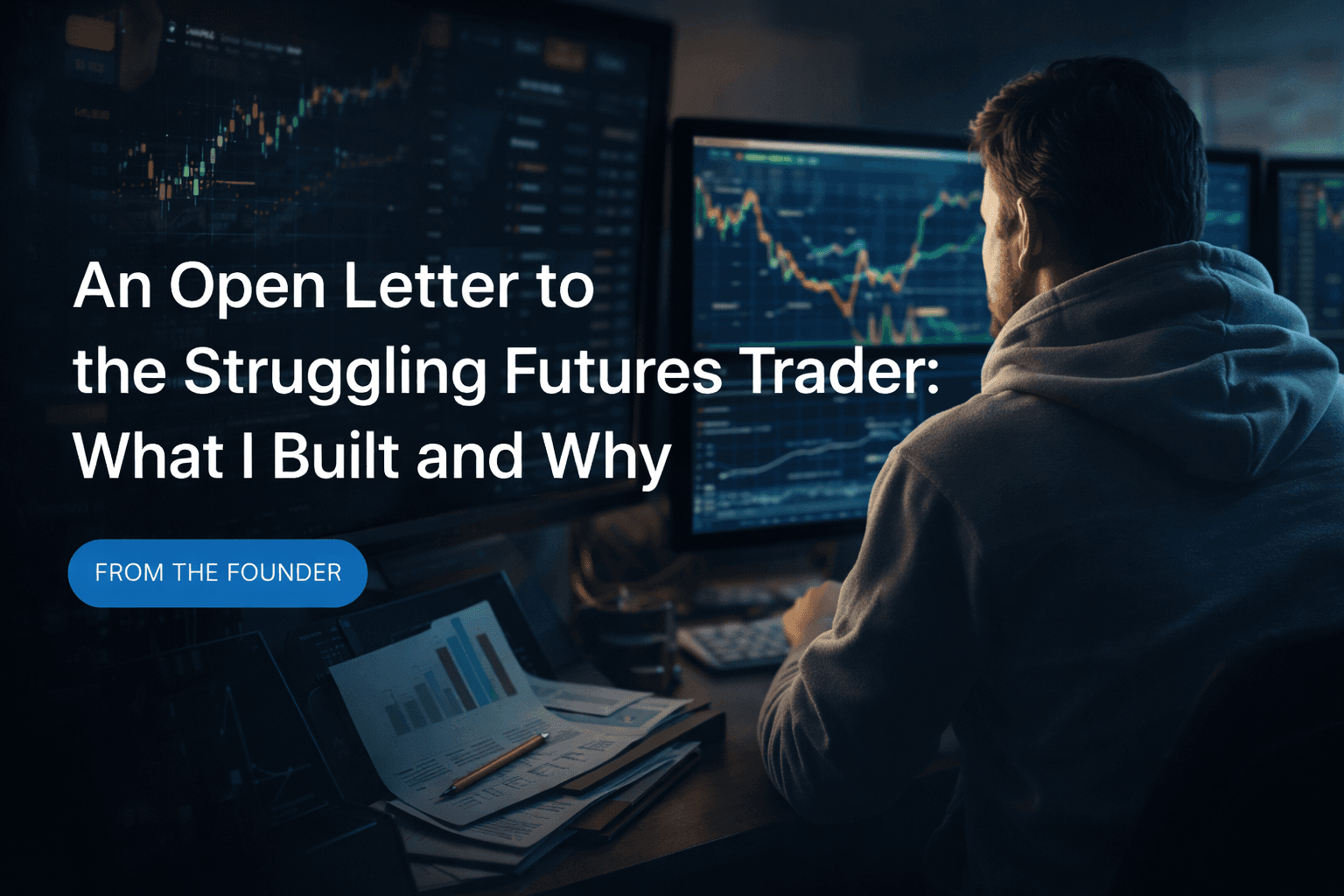
If you’re trading futures while working a job, paying bills, and trying to keep your head above water, I already know what it feels like. You want a real path forward. Not hype. Not another “one weird trick.” Not a new indicator that looks perfect only after the move is over.
Most traders are not lazy. They’re overloaded. They’re trying to learn in a world that is loud, crowded, and full of confident claims. And when you’re trading index futures, the speed and efficiency of the market can make you feel like you’re always one step behind.
This post is from me, the founder of Algorithmic, to you. I’m not writing it as a guru. I’m writing it as someone who has spent over a decade doing research and testing, still working through my own challenges, and building tools that make the market easier to read with honesty.
The retail path is crowded, and it often leads nowhere
Here’s the uncomfortable truth: most retail trading content is designed to keep you consuming, not improving.
You get:
Endless strategies with no clear process
Charts packed with indicators that disagree
“Signals” that feel good until they don’t
Hindsight analysis dressed up as certainty
And when you trade futures, the cost of confusion is real. You don’t need more opinions. You need structure you can repeat, context you can trust, and a way to review your decisions without rewriting the story afterward.
Index futures are not “human.” They’re algorithmic.
Index futures are driven by systems reacting to liquidity, flows, positioning, and time-based behaviors. That does not mean the market is “rigged.” It means you’re operating in an environment shaped by machines executing rules at scale.
So if you want a chance at consistency, your approach has to match the environment:
You need a framework that works intraday
You need reference points that stay consistent
You need charting that does not quietly change after the fact
You need a workflow built for study, replay, and verification
That is the direction I committed to.
What I actually did for over a decade
I did not “discover a secret.” I did the unglamorous work: research, backtesting, observation, and verification. Over and over.
Most people want a shortcut. I wanted something I could test.
That meant:
studying how index futures behave across sessions
tracking repeatable behaviors and common failure points
looking for structure that holds up under replay
validating ideas until they stopped breaking under real conditions
Even then, I’m not pretending I solved trading. Trading is hard. The market is adaptive. I still have my own struggles. But I’ve learned that progress comes faster when your framework is stable and your review is honest.
Why I built Algorithmic
Algorithmic exists because I wanted a better way to read and study index futures on TradingView without drowning in noise.
Not “signals to make money.”
A framework.
The goal is to help traders get off the retail treadmill and move toward something more professional:
clear structure
real-time context
objective review
fewer decisions, made at better locations
That became the Algorithmic Suite, designed as a system rather than a random collection of tools.
The system in plain English
Algorithmic is built around a simple sequence:
Define the map
Track development
Validate turning behavior
Review without hindsight
That is it.
On TradingView, that looks like:
Midnight Grid: defines session structure so you start with a roadmap instead of guessing key levels mid-session.
Quantum Vision: keeps real-time context on the chart as price develops so you don’t lose the story when things get fast.
Turning Points: highlights potential turning behavior and confirms on bar close so you can be more disciplined instead of chasing wicks.
None of that is a promise of results. It’s decision support and workflow design.
Why honest charting matters more than most people think
If you’ve ever reviewed a chart and thought, “That looks obvious now,” you know the problem.
A lot of tools look clean after the fact. Then live, they behave differently. That breaks trust and it breaks learning.
I care about honest charting because:
you can’t improve if you can’t review accurately
you can’t review accurately if the chart changes later
you can’t build confidence if your tools feel like they move the goalposts
So I build around stability and reviewability, not marketing screenshots.
Who this is for
Algorithmic is for traders who:
trade index futures and want a cleaner framework
are tired of indicator stacks and constant strategy hopping
want to study and verify what they’re seeing
want tools that support a repeatable daily process
If you want a magic lever, this isn’t it.
If you want something you can actually test, study, and build into your own rules, then you’re the right kind of person for this.
A realistic promise
I’m not here to tell you trading is easy. It’s not.
What I can say is this: your odds improve when your process improves.
And process improves when you have:
consistent reference points
less noise
clearer invalidation
better review
That’s what I’m building.
How to use this blog going forward
This blog is going to cover a lot, because traders need more than one article to get unstuck.
But it will stay anchored in a professional direction:
index futures structure (ES, NQ)
TradingView workflows
research-driven thinking
risk and review habits
updates and guides for the Algorithmic Suite
If you’re new here, start with:
The Software page (how the system works)
then one indicator page (Midnight Grid is the base layer)
then pricing and the trial, if it fits your process
If you are struggling right now
If you’re tired, overwhelmed, or unsure if you can make this work, I get it. Most traders are carrying real life on their back while trying to learn a complex skill in a noisy industry.
My goal is not to sell you a dream. It’s to give you a framework you can evaluate and a set of tools you can use to study the market more honestly.
If Algorithmic helps you reduce noise and build a repeatable workflow, that’s a win.
If it doesn’t fit your style, you’ll still have learned what a professional process can look like.
Either way, you move forward.
Note
Algorithmic is charting software for decision support on TradingView. It is not financial advice. Trading involves risk. Outcomes depend on your rules, risk management, and execution.