·
8 minutes
What Is Algorithmic Futures Trading? How Algorithmic.io Works

Algorithmic
What Is Algorithmic Futures Trading? A Deep Look at Algorithmic.io
There is a certain kind of trader this market keeps producing.
The trader who has watched too many charts. The trader who has sat through too many explanations after the fact. The trader who has heard the same concepts reworded a hundred different ways and realized that most of the trading industry is just recycling familiar ideas with a new paint job.
Anyone who has spent time around prop firms, futures Discords, X, or Reddit trading communities knows exactly what that looks like.
A framework trends. A few creators rename it. A new indicator bundle appears. Then the whole thing gets pushed as if it is some breakthrough in market understanding, when really it is just another remix of public concepts, lagging indicators, or theories that look smarter in hindsight than they ever do in a live market.
That is the environment Algorithmic.io steps into.
And to understand what Algorithmic actually is, it helps to start with what it is not.
It is not automated trading. It is not a plug-and-play bot. It is not a recycled mashup of popular retail indicators. It is not one more repackaged version of the same public trading theories that have already been repeated across the internet for years.
Algorithmic.io presents something different.
It describes Algorithmic as a proprietary futures trading framework built specifically for index futures traders who want structure, context, and cleaner decision-making on TradingView. Instead of pretending the market can be reduced to one secret line or one magical signal, the platform is built around the idea that traders need a more stable roadmap, clearer context as price develops, and more disciplined confirmation around reversals.
For traders who are tired of noise, that matters.
For prop firm traders, it matters even more.
Why traders have become so skeptical
Traders are skeptical for a reason.
The modern retail trading space has spent years conditioning people to distrust almost everything. That distrust did not come from nowhere. It came from hindsight screenshots, overfitted indicators, buzzword-heavy “systems,” and content creators who always seem to explain the move perfectly after the move is already over.
That is why serious traders usually react badly to phrases like “secret model,” “institutional algorithm,” or “smart money framework.” Too often, those phrases are just packaging. They are used to make something sound proprietary when it is actually built from the same public ideas that have been floating around for years.
And that is exactly why Algorithmic.io deserves a closer look.
The strongest thing about Algorithmic is not hype. It is not a vague promise. It is that the platform is framed around original research and proprietary structure, not around borrowed theories dressed up as something new.
That distinction is not minor. It is the whole point.
What Algorithmic actually is
Algorithmic.io is built around the idea that the market is best approached through structure first, not improvisation first.
The platform is centered on three connected indicators:
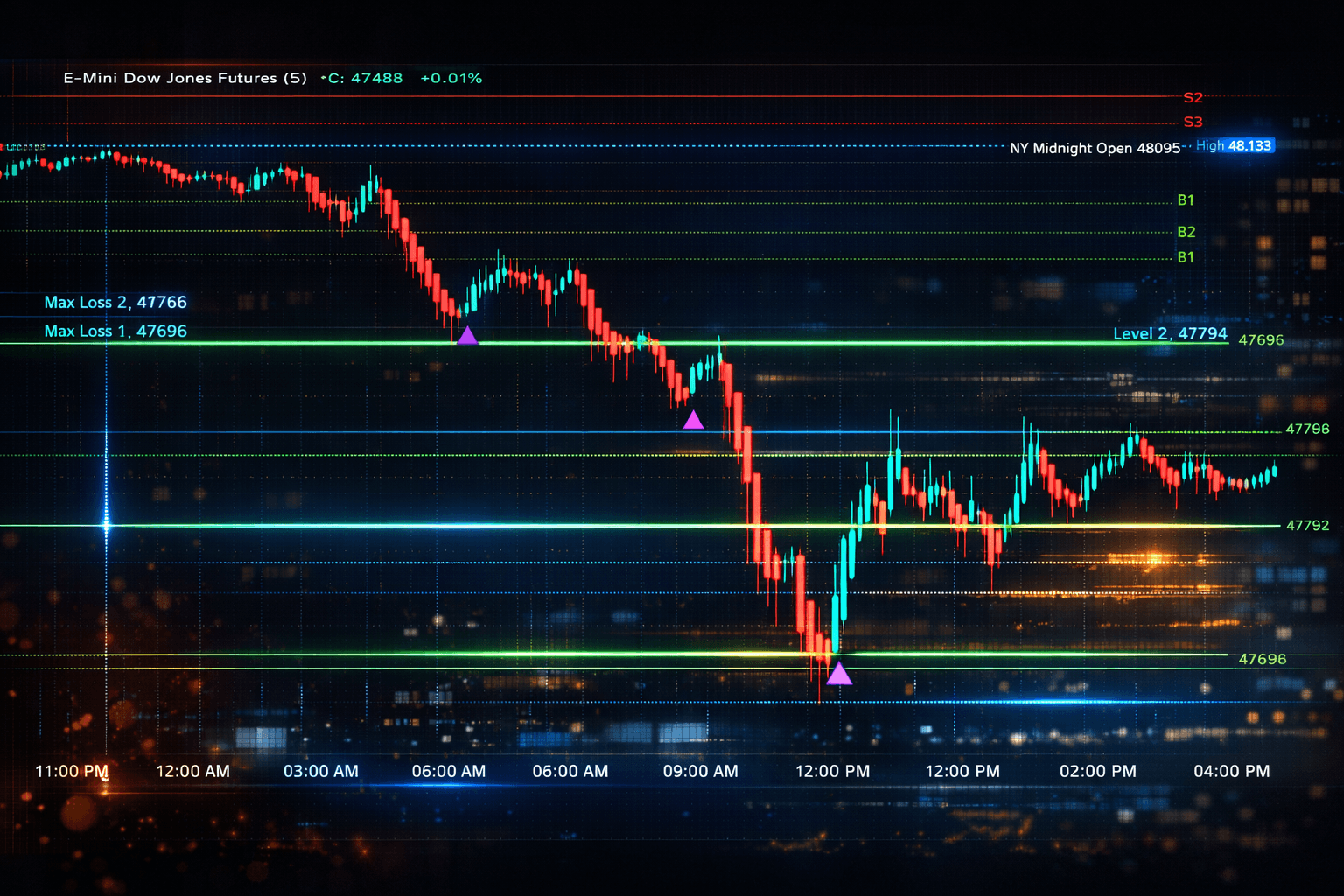
Midnight Grid
Quantum Vision
Turning Points
Taken together, they are presented as a system for reading and organizing index futures rather than chasing them.
That is a big difference from the usual retail approach.
A lot of trading products are sold like shortcuts. They imply that one tool can answer everything. One oscillator will tell a trader where to enter, when to exit, when to fade, when to size up, and when to stand down. Real traders know that is nonsense.
Algorithmic takes a different path.
Instead of pretending that one tool can do everything, it separates the job into three parts:
Map the important structure before the session unfolds
Maintain meaningful live context as price develops
Highlight reversal behavior at important locations
That sounds simple on paper, but it is actually a more serious design philosophy than most traders are used to seeing.
Because the truth is, many traders do not lose because they have zero information. They lose because they have too much random information and no consistent framework for organizing it.
Algorithmic appears to be built to solve that problem.
The proprietary angle is what makes this worth paying attention to
There are plenty of platforms that claim to help futures traders. That alone is not special.
What makes Algorithmic.io different is the claim that its framework is proprietary, not derivative.
That means the logic behind the suite is not being presented as another variation of public off-the-shelf indicators. It is not marketed as a relabeled MACD, a cosmetic moving average crossover, or a recycled “smart money” script with new colors and branding.
Instead, Algorithmic is positioned as the result of its own internal research, translated into a practical on-chart framework for index futures.
For traders who have been around the block, that should immediately stand out.
The futures space is full of products that look original until a trader stares at them for five minutes and realizes they are just familiar tools wrapped in new language. That is one of the reasons traders on Reddit tend to be brutal. They have seen enough recycled material to recognize when something is fake.
Algorithmic does not appear to lean on that usual trick.
Its identity is based on the idea that the suite was built from a proprietary market theory and then turned into a structured TradingView workflow. Whether a trader is skeptical or curious, that alone makes it more interesting than the average indicator package being sold online.
Because if something is actually proprietary, then the real question is no longer “which public indicator is this copying?”
The question becomes “does this framework create a more useful and more honest way to engage with the market?”
That is a much better question.
Midnight Grid is the part traders notice first
If there is one part of the Algorithmic suite that captures the platform’s overall philosophy quickly, it is Midnight Grid.
Midnight Grid is built around the idea that the market should not begin as a blank emotional canvas every morning. It gives the trader structure before the session gets loud.
That is important because most traders do not fail from lack of chart access. They fail because the chart becomes a mess once the day starts moving. Every candle suddenly looks important. Every minor reaction feels meaningful. Every social media opinion seems to fit the move after it happens.
Midnight Grid appears to exist to cut through that.
Instead of letting the trader invent a story in real time, it establishes a roadmap early. The result is a cleaner way to frame risk, invalidate trade ideas, and avoid turning the chart into a museum of lines that all seemed obvious after the session was over.
That is the kind of thing prop traders appreciate.
A prop firm account does not give a trader much room for confusion. Trailing drawdowns and tight rules punish emotional decisions hard. When risk parameters are tight, a trader does not need ten different opinions from ten random indicators. A trader needs structure that makes location matter.
That is what makes Midnight Grid more than a cosmetic levels tool. It appears to be the foundation layer of the entire Algorithmic framework.
Quantum Vision is where live context starts to matter
A pre-session roadmap is useful, but by itself it is not enough.
The market still evolves in real time. Price still develops behavior during the session. Reactions still need context.
That is where Quantum Vision comes in.
Quantum Vision appears to be built to keep that developing context on the chart in a way that remains meaningful during review. That is a subtle point, but it matters a lot.
A huge problem in trading is that many tools look fine live, then disappear into ambiguity later. Or the opposite happens. A chart ends up looking clean in hindsight, but the trader knows that is not what it felt like in real time.
Quantum Vision seems designed to close that gap.
Its role in the suite is not to replace the roadmap. It is to layer live context onto it. That is important because price does not just hit levels mechanically. The quality of the response matters. The developing character of the session matters. The trader needs to know more than “price touched something.”
For a discretionary futures trader, especially one trading evaluations or funded accounts, that kind of persistent context is where discipline becomes easier. It is harder to rewrite the story later when the chart kept the structure visible while the session unfolded.
That makes Quantum Vision especially relevant for traders who care about review, not just execution.
Turning Points is built for the hardest part of the chart
Every trader says they want to catch reversals.
Very few traders admit how bad they actually are at handling them.
Reversal trading is where traders become the most vulnerable to fantasy. Every chart looks clean after the turn is confirmed. Every failed attempt gets quietly forgotten. Every successful screenshot gets posted as if the reversal was obvious from the start.
That is why Turning Points may be the most psychologically important part of the suite.
Turning Points is presented as a tool for identifying reversal behavior at important locations with confirmation, not as some reckless early-call engine that tells traders to knife-catch every shift in momentum.
That distinction matters.
The problem with reversal content online is that it often turns into ego content. Traders want to be early because being early looks smart. But most blown accounts do not come from being too patient. They come from trying to call tops and bottoms where no real confirmation exists.
Turning Points appears to be designed to filter some of that nonsense out.
In the context of the full suite, it makes even more sense. A reversal tool on its own can easily become noise. But a reversal tool working off a pre-existing map and live-session context becomes much more useful. It stops being random and starts becoming selective.
That is exactly how serious traders want these tools to behave.
Why the full suite makes more sense than isolated indicators
One of the most compelling things about Algorithmic is that it is not sold like three unrelated products that just happen to live on the same website.
It is presented like a framework.
That matters because isolated indicators usually fail the moment traders expect too much from them. A levels tool cannot manage the whole session. A live context tool cannot replace a proper roadmap. A reversal tool cannot create meaningful structure out of nothing.
But together, those roles become coherent.
Midnight Grid gives the trader a map.
Quantum Vision keeps the session readable.
Turning Points narrows the focus when reversal behavior begins to matter.
That is not just better product design. It is a better reflection of how real traders actually work.
No serious futures trader should want one tool to do everything. That is not how markets work. The more realistic goal is to reduce randomness, improve consistency, and make it easier to tell whether a trade idea was based on structure or impulse.
Algorithmic seems built around that exact goal.
Why this fits prop firm traders better than generic retail tools
Prop traders live in a different mental environment than casual retail traders.
The rules are tighter. The margin for error is smaller. The emotional cost of sloppy execution is higher. Traders cannot afford to be creative in the wrong moments.
That is why tools like Algorithmic stand a better chance of resonating with prop firm traders than generic retail indicators.
Generic tools often encourage overtrading because they constantly produce “signals.” Algorithmic appears to do the opposite. Its design language points toward filtering, mapping, context, and confirmation.
That is a better fit for a trader trying to survive structured risk rules.
It is also a better fit for traders who are tired of the endless cycle of content consumption. Every futures trader knows the trap: watch five videos, collect ten new ideas, add three more indicators, then take worse trades because the chart has become unreadable.
Algorithmic does not seem to be trying to add more chaos. It seems to be trying to organize it.
That is why it feels more serious than the average retail product.
Why traders who hang around Reddit will understand the appeal
Reddit trading culture has its own language, but the underlying mindset is simple.
People there have seen too much garbage.
They have seen hindsight artists. They have seen fake gurus. They have seen indicators that magically fit every chart after the move is done. They have seen “proprietary systems” that are really just public concepts in disguise.
Because of that, most traders reading from that world are not impressed by polished marketing. They want to know whether something is actually different.
Algorithmic is interesting because it answers that question in the right way.
Not by screaming louder. Not by pretending to automate success. Not by throwing out impossible promises.
Instead, it answers by emphasizing original research, fixed structure, cleaner context, and confirmation-based decision support.
That is a much stronger way to speak to skeptical traders because it respects how they think.
A skeptical trader does not want fantasy. A skeptical trader wants a framework that still makes sense when the market is open, the PnL is moving, and the outcome is unknown.
That seems to be the exact environment Algorithmic was built for.
So what is Algorithmic, really?
Algorithmic is best understood as a proprietary index futures framework for traders who want more structure and less noise.
It is not about automation. It is not about copying the latest public theory. It is not about pretending there is one magic indicator that solves trading.
It is about building a chart environment where important locations are clearer, live context is easier to follow, and reversal decisions are less random.
For traders who are exhausted by recycled trading content, that is a strong proposition.
For prop traders trying to stay consistent under pressure, it may be even stronger.
Because the biggest edge most traders need is not another flashy concept. It is a better way to organize the market before emotion gets involved.
That is what makes Algorithmic.io worth understanding.
And in a futures industry full of rebranded noise, understanding the difference between something proprietary and something recycled is where serious traders should start.